Self-Employed CPP/QPP Contributions Payable
January 6, 2026
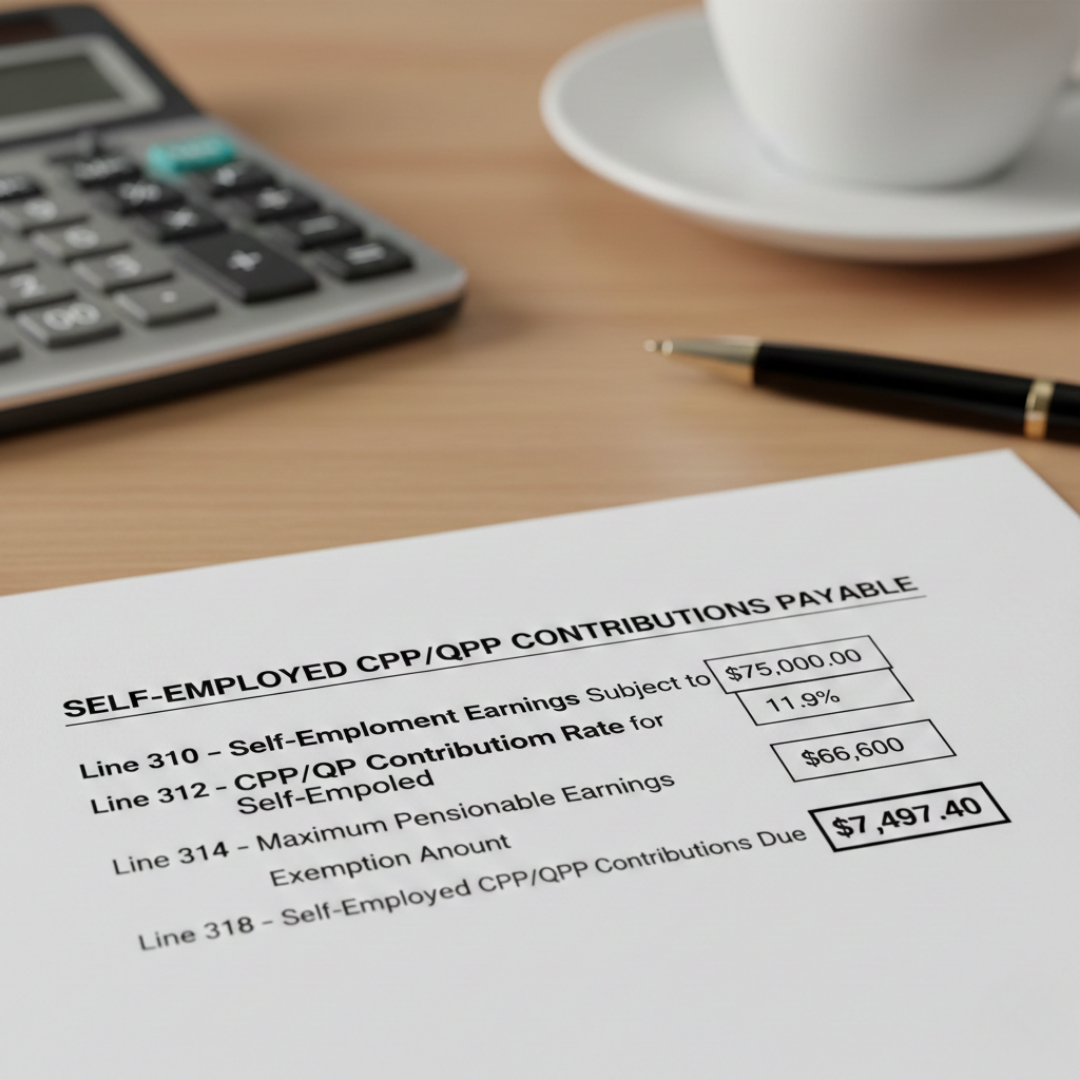
The core rule for self-employed individuals is that they are responsible for paying both the employee and the employer portions of the contributions, as they do not have a separate employer to match their share. This means the self-employed contribution rate is effectively double the standard employee rate.
The calculation is based on your net income from self-employment (after expenses).
| Description | Details |
|---|---|
| YBE (Year's Basic Exemption) | The minimum amount of income on which no contributions are required. For both CPP and QPP, this is generally $3,500. |
| YMPE (Year's Maximum Pensionable Earnings) | The maximum amount of income subject to the first tier of contributions. |
| YAMPE (Year's Additional Maximum Pensionable Earnings) | The new, higher maximum income level subject to the second (enhanced) tier of contributions (known as CPP2 or QPP2). |
| Contributory Earnings | Calculated as: Net Income (up to YMPE/YAMPE) minus YBE. |
QPP Calculation
- Year’s Basic Exemption (YBE): $3,500
- Year’s Maximum Pensionable Earnings (YMPE): $68,500
- Year’s Additional Maximum Pensionable Earnings (YAMPE): $73,200
Tier 1: Base Contribution
- Base contribution rate for self-employed: 12.80% (double the 6.40% employee-employer rate)
- Contributory earnings: $68,500 − $3,500 = $65,000
- Tier 1 contribution: $65,000 × 12.80% = $8,320.00
Tier 2: Enhanced Contribution (QPP2)
- Enhanced contribution rate for self-employed: 8.00%
- Income subject to QPP2: $73,200 − $68,500 = $4,700
- Tier 2 contribution: $4,700 × 8.00% = $376.00
Total QPP Payable: Total: $8,320 + $376 = $8,696.00
The Two Tiers of CPP/QPP Contributions (Enhancement)
The "first tier" and "second tier" refer to the two separate contribution rates applied to different ranges of your pensionable income. This structure was introduced as part of the CPP and QPP Enhancement (starting in 2019) to provide higher retirement benefits in the future.
- First Tier (Base Contribution): This is the original, established contribution required on the bulk of your income, up to the initial maximum. Applied to your net self-employment income that is above the Year's Basic Exemption (YBE) of $3,500 and up to the Year's Maximum Pensionable Earnings (YMPE). Rate is (which is the combined employee and employer rate) is 10.80% for CPP and 12.80% for QPP.
- Second Tier (Enhanced Contribution - CPP2/QPP2): This is the new, additional contribution intended to fund the "second layer" of the retirement benefit, increasing the maximum pensionable earnings limit. Applied only to a new, higher income range—income that falls above the YMPE and up to the Year's Additional Maximum Pensionable Earnings (YAMPE). Rate is 8.00% for both CPP and QPP.
The individual pays the Tier 1 rate on the majority of their income, and then a lower Tier 2 rate on the portion of their income between the YMPE and their actual income level (since their income is below the YAMPE).
How to Calculate the Payable Amount
The contributions payable is calculated on your annual tax return (Federal Schedule 8 and Quebec TP-1, Schedule R).
Example:
(non-Québec Resident, CPP, 2024): Net Self-Employment Income: $80,000
Answer: First Tier Calculation (Income up to YMPE):
Contributory Earnings: $68,500 (YMPE) - $3,500 (YBE) = $65,000
Contribution: $65,000 x 10.80% = $7,020.00
$65,000 x 2.00% = $1300.00
Second Tier Calculation (Income between YMPE and YAMPE):
Income subject to CPP2: $73,200 (YAMPE) - $68,500 (YMPE) = $4,700
Contribution: $4,700 x 8.00% = $376.00
Total CPP Payable: $7,020.00 +$1300.00 + $376.00 = $8,696.00
How to do on TaxTron?
Navigate to the Income section and select 'Self-Employment Income'. Complete the federal Business Statement of Income and Expenses; the data will automatically transfer to the required Québec forms

Tax Treatment
Self-employed individuals receive favorable tax treatment for their doubled contributions:
- Deduction (Line 22200 / Line 222 - Federal/Provincial): Half of the total self-employed contribution amount is claimed as a deduction to reduce your net income. This is treated like the employer portion.
- Tax Credit (Line 31000 / Line 350 - Federal/Provincial): The other half of the contribution is claimed as a non-refundable tax credit, calculated at the lowest marginal tax rate. This is treated like the employee portion.